Buying a Coastal Home in SLO County? Salt Air Can Cost You $80K
How much can salt air damage cost a coastal home in San Luis Obispo County?
A coastal home in Pismo Beach, Shell Beach, or Avila Beach that goes three to five years without regular maintenance can carry $40,000 to $80,000 in deferred repairs, and much of it won't show during a standard walkthrough. Salt air corrodes metal, lifts paint, hazes glass, and builds up fastest under covered porches where rain never rinses it. Checking the HVAC condenser, exterior hardware, windows, flashing, and paint before you write an offer, then rinsing the house with fresh water every month after you move in, keeps those costs predictable.
By Patrick Raymond | [Publish Month Day, Year]
You found the coastal home you've been searching for. Ocean views, marine layer mornings, the sound of the water from the back deck. You close escrow and move in.
Six months later, the HVAC system starts struggling. A year after that, the exterior paint is bubbling. Two years in, you're replacing light fixtures on a covered porch you barely use.
Nobody mentioned any of this before you bought, but the cause is predictable: salt air. If you're buying anywhere within a couple of miles of the water in San Luis Obispo County, this is the due diligence most buyers don't get until after closing.
Why Salt Air Is Harder on a Home Than You'd Expect
Salt in coastal air isn't inert. It's hygroscopic, which means it pulls moisture out of the atmosphere and holds it against every surface it lands on.
That leaves every hinge, window latch, and exterior fastener sitting in a thin, constant film of brine. Brine conducts electricity, so the house behaves like a low-grade battery terminal around the clock, and corrosion that would take years inland can happen in months near the water.
With my appraisal background and 24 years of walking homes across this county, I sort coastal damage into three lanes:
- Metal corrosion. HVAC coils fail ahead of schedule, structural fasteners weaken at framing connections, and door hardware pits and seizes.
- Surface degradation. Salt deposits haze glass over time, work beneath paint and lift it from the siding, and dry out exterior wood until it's open to rot.
- Hidden accumulation. Rain doesn't clean a coastal house. It rinses some salt off open surfaces, but it also drives salt into cracks, window tracks, caulk joints, and weep holes, where it stays and keeps working.
Here's the number worth remembering: a coastal home left without active maintenance for three to five years can see $40,000 to $80,000 in deferred repairs. Most of it is invisible to a buyer touring on a sunny Saturday.
Your Coastal Walkthrough Checklist
Staging isn't an inspection. Walk past the furniture and the fresh-paint smell, and check these five areas before you write an offer. The cost ranges below are typical for the Central Coast as of late 2026, and your actual numbers depend on the home's size and condition.
- The HVAC condenser. Look at the thin metal fins around the outdoor unit. White, chalky residue, discoloration, or visible corrosion means the system is already working harder than it should. A replacement typically runs $8,000 to $18,000, so budget for it or negotiate it into the price.
- Exterior hardware. Check hinges, railing post anchors, and exposed fasteners for pitting, the small holes that form where chloride has eaten into the metal. Pitting means replacement, not cleaning, and compromised railing fasteners are a safety issue, not a cosmetic one.
- Windows and doors. Angle yourself to look at the glass rather than through it. A foggy haze that stays in direct light is salt etching, and it won't polish out. Window replacement on a coastal home typically runs $800 to $2,000 per opening. Sticky or stiff latches mean the mechanism is corroding inside.
- Roof flashing and gutters. Ask your inspector to look closely at the metal flashing where the roof meets chimneys, dormers, and skylights. Corroded flashing shows up months later as a ceiling stain. Look for rust streaks below downspouts and gutter hangers pulling away from the fascia.
- Exterior paint. Walk right up to the walls. Bubbles or small blisters in the paint film mean salt-laden moisture is already behind it, and that calls for a scrape, prime, and repaint, typically $15,000 to $35,000 on a two-story home.
Most standard inspections check function: does the window open, does the latch engage. They don't always flag the early-stage corrosion that tells you what a system will cost you in 18 months. If something looks off, we advise our clients to get a second opinion from a contractor who works on coastal homes specifically.
The Shelter Trap: Why Covered Fixtures Fail First
Common sense says anything under a roof is protected. On the coast, the opposite is often true.
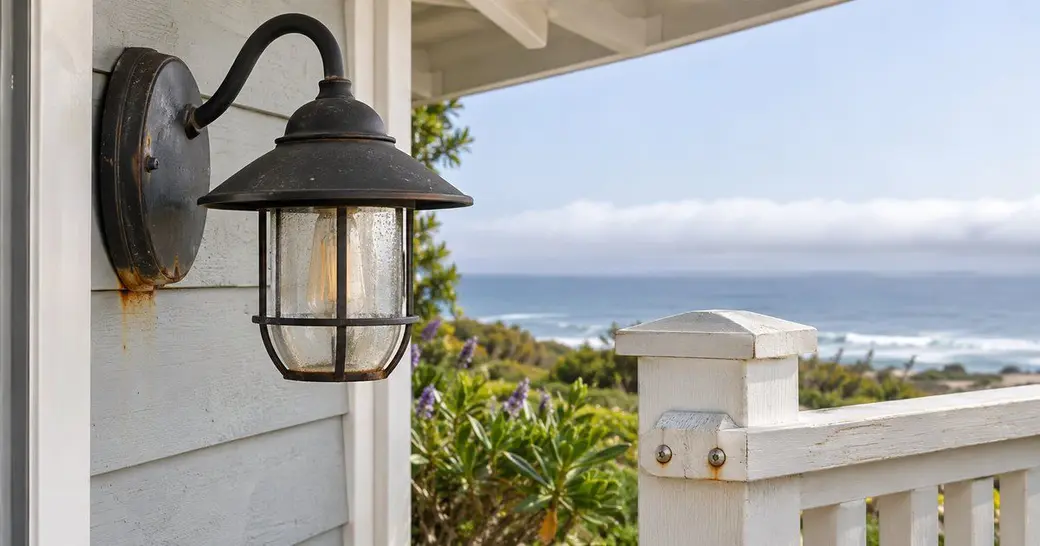
Salt air drifts under rooflines and settles on every surface, covered or not. A fixture out in the open at least gets an occasional rinse from rain. A fixture under a covered porch never does, so the salt builds into a crust that holds humidity against the metal all day and night.
The failure follows a predictable sequence:
- Pitting. Chloride works through the paint coating, leaving tiny spots that look like pinpricks.
- Galvanic corrosion. Once the coating is breached, different metals inside the fixture react with each other and corrosion speeds up sharply.
- Internal migration. Salt reaches the wiring connections, and you see flickering, tripped GFCI outlets, or outright failure even though the bulb is fine.
On any coastal home you tour, look up at the porch ceiling fans. Rust bleeding through the motor housing and pitted blade brackets mean the fan is at the end of its service life, even if it still spins. Plan on $400 to $1,200 per marine-grade replacement. The same trap applies to porch lights, outdoor speakers, outdoor outlets, and patio furniture anchors.
Coastal-Grade Materials That Hold Up
If you're negotiating repairs or planning a renovation, material choices decide how much you'll spend on maintenance for the next 20 years. The table below compares standard materials with coastal-grade upgrades across seven components that matter most to Central Coast homeowners.
| Component | Standard Material | Coastal-Grade Upgrade | Why It Holds Up |
|---|---|---|---|
| Exterior metal hardware | 304 stainless or plated steel | 316 marine-grade stainless steel | Molybdenum in the alloy resists chloride corrosion |
| Aluminum fixtures and railings | Thin anodized aluminum | Thick marine-grade powder-coated aluminum | Heavier coating resists pitting |
| Decorative hardware | Plated or painted steel | Solid brass or solid bronze | Develops a patina instead of pitting |
| Siding | Painted wood siding | Fiber cement siding | Resists moisture and rot and holds paint longer |
| Exterior trim | Wood trim board | PVC trim board | Absorbs no moisture and won't rot or split |
| Decking | Wood decking | Capped composite decking | No annual sealing required |
| Flooring near exterior doors | Solid hardwood | Porcelain tile or humidity-rated luxury vinyl plank | Won't cup or buckle in coastal humidity |
The pattern is consistent: the coastal-grade option costs more up front and saves you repeated replacement cycles. On hardware alone, 316 stainless versus the 304 stainless sold at most hardware stores is the difference between years and decades.
The Fresh Water Flush and Other Low-Cost Habits
The single most effective habit for a coastal homeowner costs almost nothing. Once a month, take a garden hose and rinse:
- Exterior walls, window tracks, and sills
- The HVAC condenser, gently and at low pressure
- Covered porch fixtures, only where water can't reach the electrical
You're washing salt off before it bonds and forms a crust, which breaks the corrosion cycle before it starts. It takes about 20 minutes and prevents thousands of dollars in accelerated wear.
Two more habits round it out. Twice a year, apply a marine-grade corrosion inhibitor such as Boeshield T-9 to porch light hardware, railing hardware, and exposed fasteners. Once a year, walk the perimeter and look for cracked, shrinking, or missing caulk around windows, doors, vents, and utility lines. A tube of caulk is about $10, while water damage behind a wall can run $5,000 to $20,000.
If you're selling a coastal home, keep records: HVAC service receipts, your rinse schedule, and caulk inspection notes. Buyers who understand coastal maintenance will pay more for a home that proves it's been cared for, and I've seen that documentation shape pricing conversations directly.
Is a Coastal Home Still Worth It?
Every home has a maintenance profile. A 1960s ranch in Atascadero comes with dry rot risk, older electrical, and galvanized plumbing. A new build in Nipomo comes with HOA rules and landscaping costs. A coastal home comes with salt air.
The difference is that the coastal profile is predictable. You know what to watch, which materials to specify, and that the monthly rinse works. The buyers who get into trouble are the ones who didn't know what they were buying.
Homes in Shell Beach, Pismo Beach, and Avila Beach hold their value because people want to live there, and the lifestyle is real. You just need to go in with your eyes open, and every home's numbers are different. That's where a walkthrough with someone who knows this coastline makes the difference.
Frequently Asked Questions
How much does salt air damage cost to repair on a coastal home in San Luis Obispo County?
A coastal home in Pismo Beach, Shell Beach, or Avila Beach that goes three to five years without regular maintenance can carry $40,000 to $80,000 in deferred repairs. The largest items are usually HVAC replacement at $8,000 to $18,000, exterior repainting at $15,000 to $35,000 on a two-story home, and window replacement at $800 to $2,000 per opening.
Does a standard home inspection catch salt air damage?
Not always. Most inspections confirm that windows, latches, and systems work, but they may not flag early corrosion on HVAC fins, flashing, or exterior fasteners. On a coastal home near the Central Coast shoreline, ask your inspector to look specifically for corrosion and get a second opinion from a contractor who works on coastal properties.
Why do covered porch fixtures corrode faster near the coast?
Salt air drifts under rooflines, but rain never reaches covered surfaces to rinse it away. The salt builds into a crust that traps humidity against the metal, so porch lights, ceiling fans, and outdoor outlets often fail before fixtures exposed to the weather.
How often should you rinse a coastal home to prevent salt damage?
Rinse the exterior walls, window tracks, and HVAC condenser with a garden hose once a month, using low pressure on the condenser. Add a marine-grade corrosion inhibitor to exterior hardware twice a year and inspect caulk around windows, doors, and vents once a year.
Salt air damage on a coastal home is predictable, and the costs only get out of hand when buyers don't know what to look for. A careful walkthrough before you write an offer and a few low-cost habits after you move in protect one of the best lifestyle investments on the Central Coast.
We walk our clients through exactly this kind of due diligence on coastal properties in Pismo Beach, Shell Beach, and Avila Beach, so you know what you're buying and what it will take to care for it.
Considering a move to San Luis Obispo County? Explore our free Central Coast Relocation Guide: raymondteamre.com/the-central-coast-relocation-guide
Ready to talk through your situation? Schedule a meeting with the Raymond Team — call us at 805-201-6341, or book a Zoom at book.raymondteamre.com.
About Patrick Raymond
Patrick Raymond brings a rare edge to real estate: an appraisal background backed by 24 years of experience. It defines how he approaches pricing, market shifts, and true property value — grounded in data, not assumptions. He also guides clients through complex 1031 exchanges, with a sharp focus on timing and reinvestment strategy. Serving San Luis Obispo County, Patrick brings clarity to complex decisions — because in real estate, the numbers always matter.
Categories
- All Blogs (11)
- Buyers Guide (5)
- Cambria, Templeton, Pismo Beach, Paso Robles, Nipomo (1)
- downsizing (1)
- Home Insurance (1)
- Insurance (1)
- Moving to SLO County (3)
- relocations (6)
- San Luis Obispo, Pismo Beach, Arroyo Grande, Grover Beach, Avila Beach, Morro Bay, (3)
- Sellers (4)
- Selling (4)
- selling to move (3)
Recent Posts